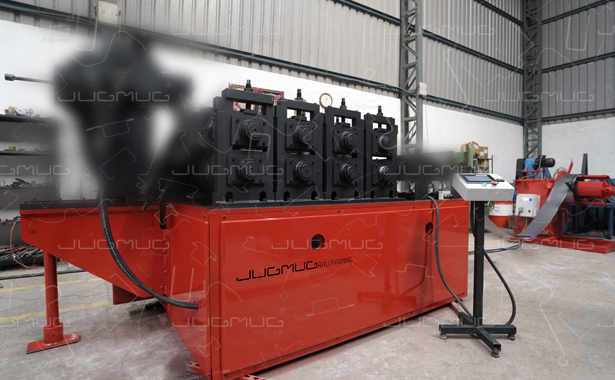
In today’s competitive manufacturing industry, choosing the right machinery can directly impact production speed, product quality, and overall business profitability. When it comes to metal fabrication, roll forming machines play a major role in producing precise and consistent profiles for industries such as construction, automotive, infrastructure, electrical systems, and warehousing.
However, many manufacturers face a common question before investing: should they choose a custom roll forming machine or a standard roll forming machine?
Both options offer unique advantages, and the right choice depends on your production requirements, budget, product complexity, and long-term business goals. Understanding the differences between the two can help businesses make a smarter investment decision.
What Is a Standard Roll Forming Machine?
A standard roll forming machine is a pre-designed machine built to manufacture commonly used metal profiles. These machines are produced with fixed specifications and are suitable for standard applications that do not require major customization.
Roll forming machine manufacturers generally use standard machines to produce products such as:
- Roofing sheets
- C channels
- U channels
- Stud and track profiles
- Guardrails
- Basic structural sections
Since these machines are designed for mass-market applications, they are usually available faster and at a lower initial cost.
Advantages of Standard Roll Forming Machines
Cost-Effective Investment
One of the biggest advantages of standard roll forming machines is affordability. Since the design and tooling are already developed, manufacturers do not need to spend extra on engineering or customisation.
This makes standard machines ideal for:
- Small businesses
- Startups
- Limited budgets
- Companies producing common profiles
Faster Delivery Time
Standard machines are often readily available or require minimal production time. Businesses can start manufacturing quickly without waiting for extensive design approvals or custom tooling development.
Easier Maintenance
Because standard machines follow common industry specifications, spare parts and maintenance services are usually easier to access. Operators are also more familiar with these systems, reducing training requirements.
Proven Performance
Roll forming machine manufacturers test the standard machines in the market and offer reliable performance for routine production needs. Businesses manufacturing common products can depend on stable and predictable output quality.
Limitations of Standard Machines
Although standard machines are practical for many applications, they may not suit businesses with specialized production requirements.
Some common limitations include:
- Limited flexibility
- Fixed profile designs
- Difficulty handling complex shapes
- Lower adaptability for future product changes
- Possible production inefficiencies for unique applications
If your business requires highly specific dimensions, advanced punching systems, or unique product designs, a standard machine may not fully meet your needs.
What Is a Custom Roll Forming Machine?
A custom roll forming machine is specially designed according to the manufacturer’s production requirements. Every aspect of the machine, including tooling, dimensions, automation level, punching systems, cutting systems, and material handling, is tailored for a specific application.
Custom machines are commonly used in industries that require:
- Specialised metal profiles
- High-volume production
- Precision engineering
- Complex shapes and dimensions
- Automated production systems
These machines are built after detailed consultation between the machine manufacturer and the customer.
Advantages of Custom Roll Forming Machines
Designed for Your Exact Requirements
The biggest benefit of a custom machine is that it matches your production needs perfectly. Whether you need unique profile dimensions, special punching patterns, or high-speed automation, the machine is engineered specifically for your operations by roll forming machine manufacturers.
This improves:
- Product accuracy
- Production efficiency
- Material utilization
- Workflow optimization
Higher Productivity
Custom roll forming machines are designed to reduce manual intervention and maximise production speed. Automated feeding, punching, cutting, and stacking systems help manufacturers increase output while reducing labour costs.
For large-scale manufacturers, this leads to significant long-term savings.
Better Product Quality
Since the tooling and roll forming machine structures are built specifically for a particular product, custom machines often deliver superior profile consistency and dimensional accuracy.
This is especially important in industries where precision is critical, such as automotive components, solar mounting structures, and infrastructure systems.
Limitations of Custom Machines
Despite their advantages, roll forming machine manufacturers agree that custom machines also come with certain challenges.
Higher Initial Investment
Custom roll forming machines require additional engineering, design, and tooling development. As a result, the upfront investment is usually higher than that of standard machines.
Specialized Maintenance
Custom roll forming machines may require specialized technical support and customized spare parts, depending on the machine configuration.
Which Machine Is Better?
There is no one-size-fits-all answer. The better option depends entirely on your manufacturing goals and production requirements.
A standard roll forming machine is suitable if:
- You manufacture common metal profiles
- You need a lower-cost solution
- You want faster machine delivery
- Your production requirements are simple and repetitive
On the other hand, a custom roll forming machine is ideal if:
- You produce specialised products
- You require high precision and automation
- You plan for large-scale production
- You need flexibility for future expansion
- You want to improve operational efficiency
For many roll forming machine manufacturers, investing in a custom machine provides better long-term returns despite the higher initial cost.
Final Thoughts
Both custom and standard roll forming machines have their own advantages in modern manufacturing. Standard machines offer affordability, simplicity, and quick deployment, while custom roll forming machines provide flexibility, precision, and higher production efficiency.
Before making a decision, businesses should carefully evaluate factors such as production volume, profile complexity, budget, automation requirements, and future growth plans.
Partnering with an experienced roll forming machine manufacturer can help you identify the most suitable solution for your industry needs. The right machine investment not only improves production quality but also strengthens long-term business competitiveness in an evolving industrial market.